



OPENING DOORS
THROUGH STEM
At a New York STEM Camp, students tested, explored,
failed and tried again with incredible results.
How NativityMiguel Students Built Confidence, Curiosity, and Problem-Solving Skills with DataSnap
At NativityMiguel Middle School in Buffalo, New York, creating opportunities for students goes beyond academics. The school’s mission focuses on helping students discover possibilities they may not otherwise encounter and building the skills needed to succeed both in and beyond the classroom.
As part of a summer STEM program, NativityMiguel students used CreXo’s DataSnap STEM Labs to design, build, test, and improve projects. While students learned science and engineering concepts along the way, teachers and administrators found that the experience also fostered collaboration, resilience, creativity, and confidence.
For Principal and Assistant Head of School Michael Russell, the connection between hands-on STEM learning and the school’s mission was immediate.
Making STEM Accessible for Students and Teachers
One of the program’s strengths was its ability to engage students regardless of their previous STEM experience.
Many students entered the summer program with little background in engineering or design. Rather than beginning with abstract concepts, they were immediately challenged to build, test, modify, and improve their ideas.
Science teacher Mahly’k Fred saw the impact firsthand.
“A lot of my students didn’t even know the correct terms for the bolts or the nuts or the wrench,” he said. “Being able to give them hands-on experience and let them work directly with these materials was something I found very valuable.”
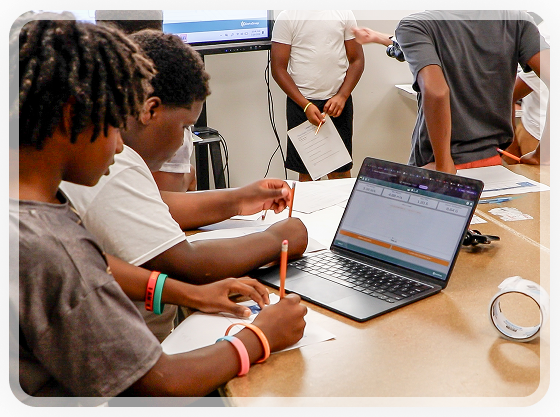
As Mahly’k students assembled projects, they also developed communication and teamwork skills by working together to solve problems.
The accessibility extended beyond students. Fred, whose academic background is in biology, initially worried about teaching engineering-focused activities. Those concerns quickly faded once he began using the curriculum materials and guiding students through the projects. Within days, he watched students who had never experienced a class like this become fully engaged in the work.
“A lot of them told me they’ve never had a class like this before,” Fred said. “The opportunity to physically build a project and then test it was completely new to them.”
What Is DataSnap?
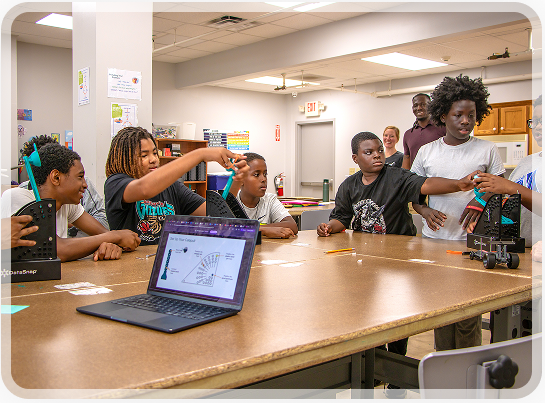
DataSnap STEM Labs combine hands-on engineering challenges with real-time data collection, helping students see science and engineering concepts in action. Using wireless sensors and interactive activities, students build projects, test their designs, and instantly measure results such as speed, distance, velocity, force, and impact.
Each lab guides students through the engineering design process while encouraging critical thinking, collaboration, and problem-solving. By turning experiments into measurable discoveries, DataSnap helps students connect abstract STEM concepts to real-world applications.
Learning Through Failure — and Trying Again
During NativityMiguel’s STEM camp, students used the engineering design process to solve challenges and improve their results. Their first attempts were not always successful, but that became part of the learning experience.
In the DataSnap Impact Lab, students designed protective spacecraft intended to keep a DataSnap sensor, acting as an astronaut, safe during a simulated landing. Some designs failed dramatically.
“We kind of suffocated it,” admitted Noelle, a fifth-grader, after her group’s spacecraft failed to protect the astronaut.
Rather than becoming discouraged, students immediately began discussing improvements they could make.
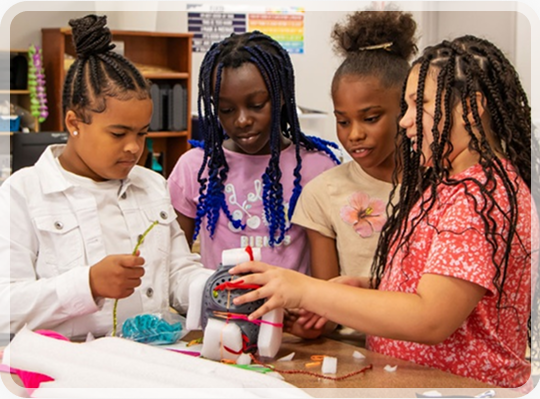
Noelle suggested trying different materials next time, while other students explored how changing weight, cushioning, or placement could affect the outcome.
For fifth-grader Lily, the experience reinforced an important lesson: “I learned that some ideas work and some ideas don’t,” she said.
Ava, another student participant, took the idea even further.
“You can do it multiple times if you need to,” she said.
Those moments illustrated one of the most valuable aspects of engineering education: the understanding that failure is not the end of the process. It is often the beginning.
Russell believes those lessons extend far beyond STEM activities.
“The engineering design process isn’t always linear,” he said. “Students might get to one step and realize they need to go back and rethink something before moving forward. That’s a valuable lesson.”
Turning Data into Discovery
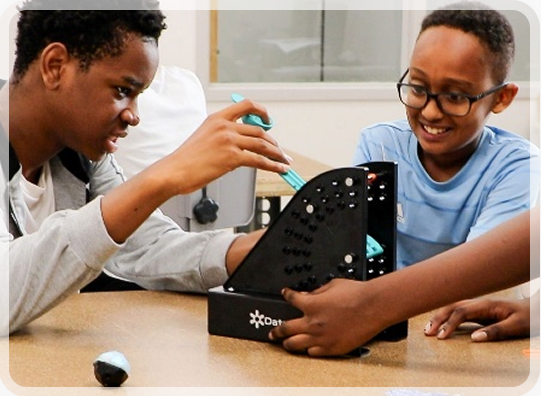
As students launched racers, tested catapults, and measured impacts, DataSnap helped them connect their experiments to real-world scientific. The ability to see data immediately made those concepts more meaningful. Carol Rosa, a longtime NativityMiguel staff member who has served in numerous support and instructional roles, appreciated how quickly students could connect their actions with measurable results.
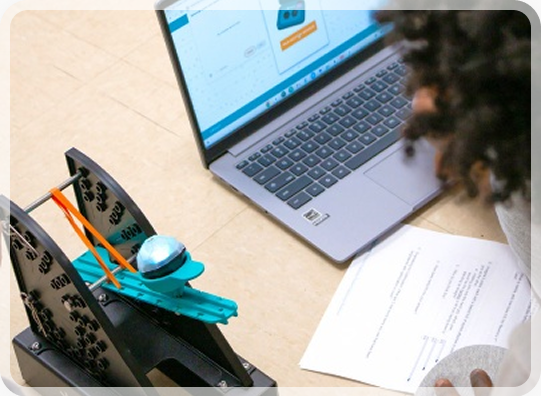
“They’re learning, but then they’re putting their work into action,” Rosa said.
For many students, seeing their results displayed in real time sparked curiosity about concepts they had never encountered before.
One student, Keilianie, had a particularly memorable takeaway.
“I didn’t even know velocity was a word,” she said. “I learned what it means. I also learned about distance. I thought distance meant something different before, but now I understand it better.”
The projects provided an opportunity to move beyond definitions and formulas. Students saw how variables such as force, speed, distance, and impact influenced the success of their designs.
Noelle was especially fascinated by the data collection process.
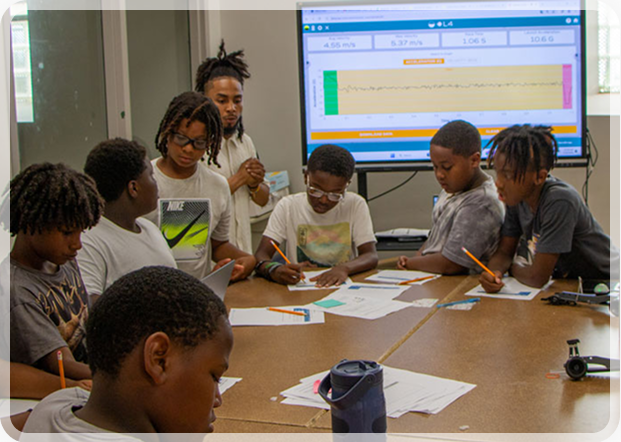
“I thought that was really cool,” she said while describing how DataSnap tracked speed, velocity, and other measurements during testing. The ability to test ideas and immediately see results encouraged students to ask questions, make observations, and think critically about why one design succeeded while another failed.
Building Skills That Last Beyond the Lab
While engineering concepts remained central to the program, educators repeatedly observed another benefit: students were developing skills they could use anywhere. Working in teams required students to communicate, share ideas, listen to one another, and solve problems together.
Rosa saw those interactions happen throughout the summer.
“It opens their minds and gives them new ways of thinking about how things are made or how things are done,” she said.
She also noticed the sense of pride students experienced when their projects began taking shape.
Whether they were building a racer, designing a spacecraft, or analyzing results, students became invested in the process because they were creating something of their own.
For Russell, that sense of ownership is one of the most important outcomes of STEM education.
“At the end of the day, it’s learning by doing, learning by playing, learning by trying,” he said. “Those experiences translate across every subject area.”
Opening Students’ Eyes to What’s Possible
The ultimate goal of the summer program was not simply to teach STEM concepts. It was to help students see new possibilities for themselves.
Rosa believes experiences like these can leave lasting impressions. “It might really just spark an imagination,” she said.
Several students expressed interest in continuing STEM activities in the future.
“I think that this was a really cool project, and I would like to do other things like this again,” Noelle said.
That enthusiasm is exactly what NativityMiguel hopes to inspire.
As Russell explained, “We are trying to open our students’ eyes to what’s possible within themselves.”
By giving students the opportunity to experiment, collaborate, and learn from both success and failure, DataSnap STEM Labs helped them do exactly that.